
An ingenious mainstay of Inuit life
The qamutiik has been a steadfast feature of Inuit art since before recorded history. These ingenious inventions are found all across Inuit Nunangat (Inuit homelands) and, although there are regional variations, the basic design is the same. Originally invented to be pulled by dogs and made of wood with bone or antler runners coated in mud, they now have Teflon runners and are most often hitched to the back of a snowmobile. Each rung was tied by hand to allow flexibility while travelling on rough terrain. Their history is traced in artwork from all across Canada, and they are represented well in the Art Bank collection.
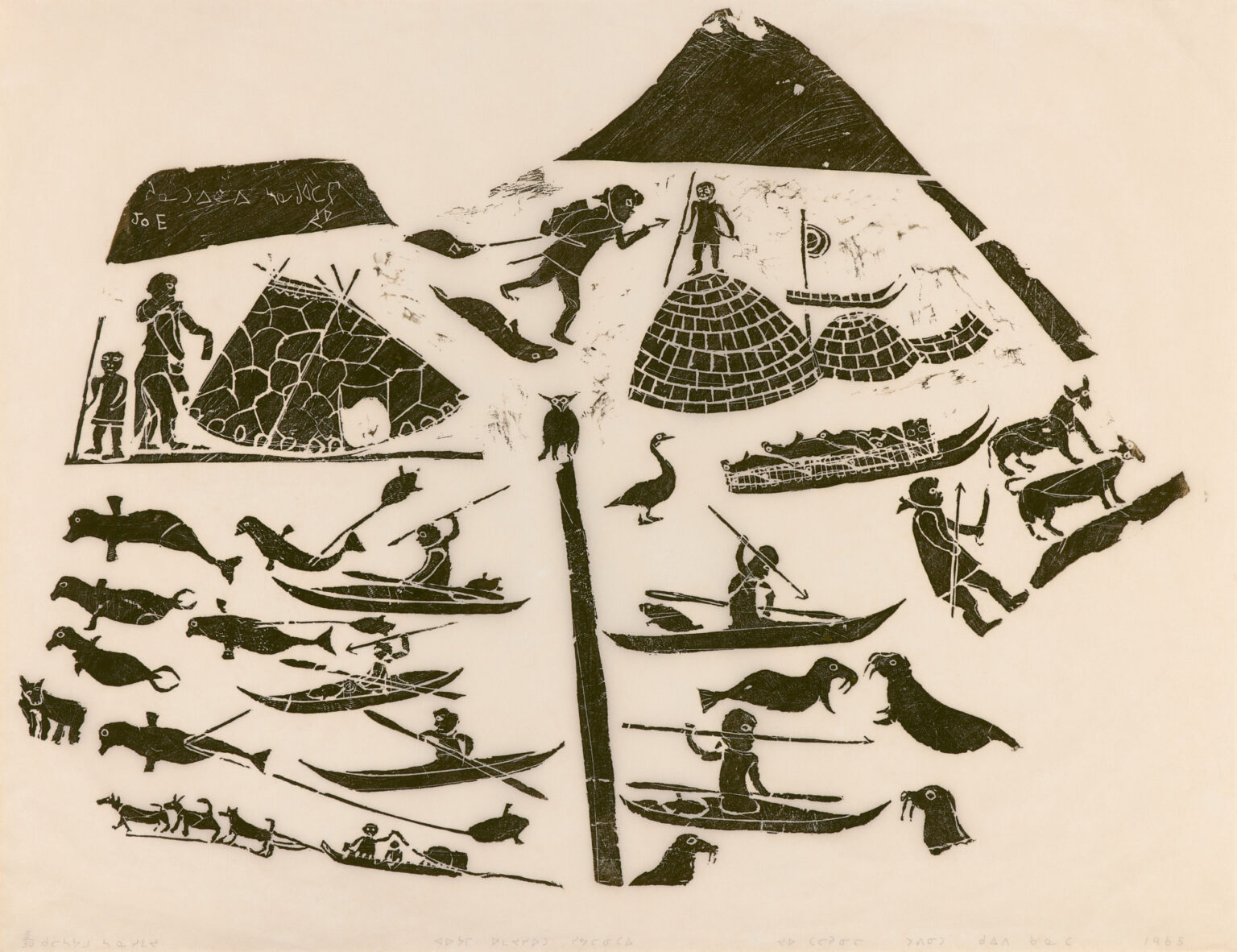
Joe Talirunili is well known for his “migration” sculptures of Inuit boats with sails, but, in this print from the early Inukjuak stone-cut printmaking collections, Hunting of Yesteryears (1965), qamutiiks are included in scenes of early camp life. A group of men are hunting seals and walrus in kayaks. On shore, a woman is taking meat into the tent while another figure drags a freshly harvested seal across the camp for processing. Outside an igloo, a qamutiik is laden with seals ready to be cleaned. Solid black figures are starkly contrasted against the white paper, and all the essential tools are rendered with care. In the background is a distinctly shaped hill, and I would guess most people from Puvirnituq (Nunavik) would be able to tell you where this camp is located. Talirunili seems to have created a visual record of traditional camp activities that will endure for future generations.
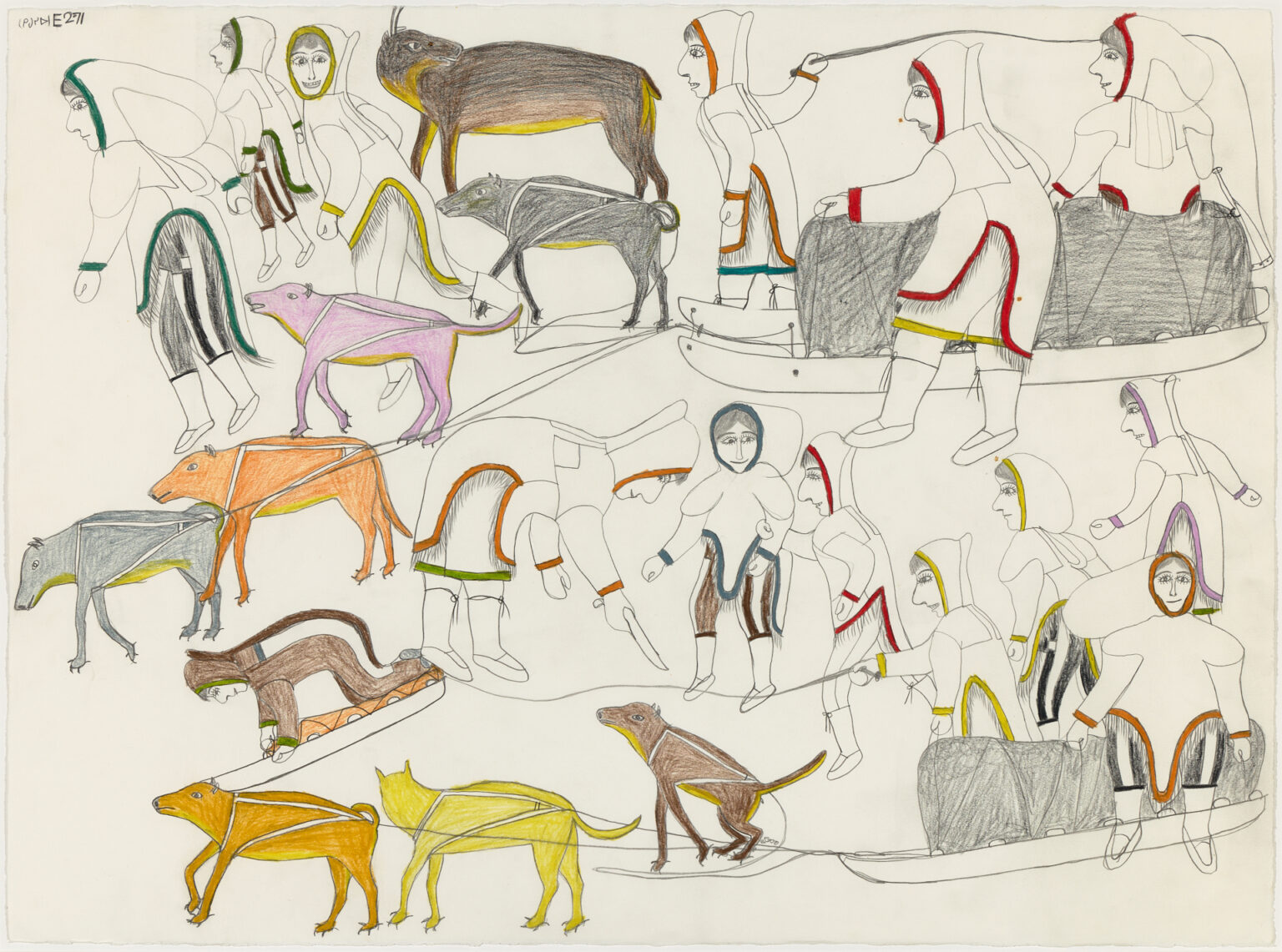
Baker Lake artist Janet Kigusiuq also remembered the time period before Nunavummiut (the people of Nunavut) settled into towns and before the introduction of snowmobiles. In an untitled piece from 1976, she also uses flattened perspective to show what is most likely two families moving from one camp to another. Large bundles of their belongings are piled onto the qamutiiks and a couple of the women sit on top, watching the children play. It looks as if one man is testing the snow in preparation for igloo making, and some of the children are playing with a qamutiik. Kigusiuq’s lines are graceful and self-assured, and the figures are closely aligned, creating jigsaw puzzle-like negative spaces across the page. The composition reflects the closeness of the families being depicted. Creative license is taken when adding colour to the dogs, with glowing magenta, orange and yellow accentuating the red and yellow trim of the people’s clothing.
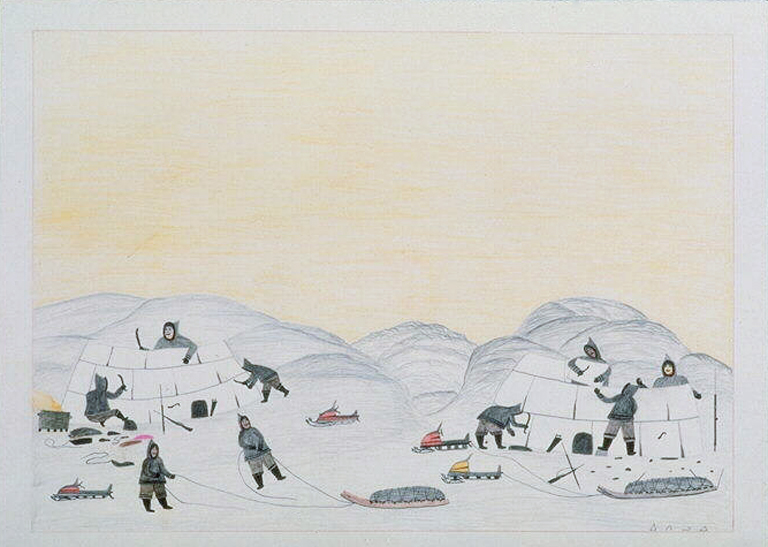
Let us compare this with a work by Etidlooie Etidlooie, of Kinngait, formerly Cape Dorset, Nunavut. In Untitled #14 (1976), Etidlooie shows a group of men after their arrival at a hunting camp. We can see them quickly building igloos and putting away their sleds and belongings, racing against the dying light. Parked alongside the igloos are colourful red and yellow snowmobiles. Their vivid hues contrast with the natural colours of the hunter’s belongings while accenting the pale orange sky overhead. During this time when dogs are being replaced by faster, gas-powered machines, the qamutiik endures.
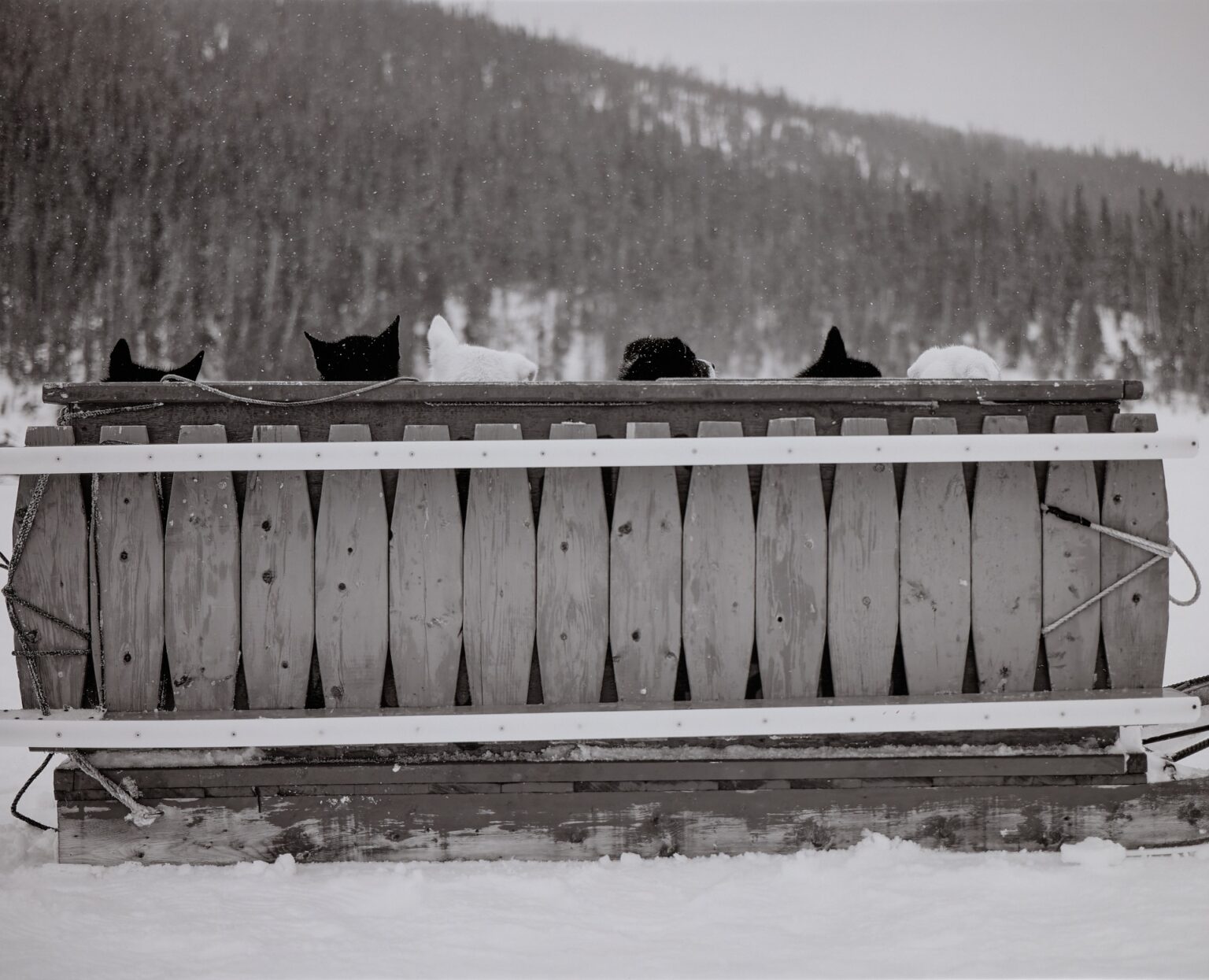
As an Inuk artist from Rigolet, Newfoundland and Labrador (Nunatsiavut), I was pleased to see that the collection has a work from photographer Eldred Allen, also from Rigolet. In Boxed (2022), Allen has tightly framed an image of a dog team travelling inside a qamutiik box with the racing sled strapped to its side. The straight-edged rungs contrast with the whimsical dog’s ears peeking up from behind their wooden enclosure. It aptly symbolizes the contemporary role of the qamutiik as an emblem of Inuit material culture that has been adapted to these times while retaining its original essence. As with so much of our Inuit culture, it endures because of its flexibility and strength.

About the author: Heather Campbell
Heather Campbell is an Inuk artist originally from Rigolet, in Nunatsiavut, who is currently based in North West River, Newfoundland and Labrador. She has a Bachelor of Fine Arts from Memorial University of Newfoundland. Her art was included in the exhibition Gather: In Celebration of Year of the Arts, at The Rooms, in St. John’s, Newfoundland and Labrador, from May 18 to September 22, 2024. Her paintings can be found in the collections of The Rooms, Crown-Indigenous Relations and Northern Affairs Canada and the Montreal Museum of Fine Arts, in Montréal, Quebec.
